Maine's revised adult-use cannabis testing rules take effect 7 December 2026
Maine's Office of Cannabis Policy says its revised testing rules, 18-691 CMR ch. 5 and ch. 40, take effect on Monday 7 December 2026. They write into the rules the edible-testing relief already in statute since 19 April 2026, and add new duties for testing facilities.
By Neil Cartwright · · 6 min read
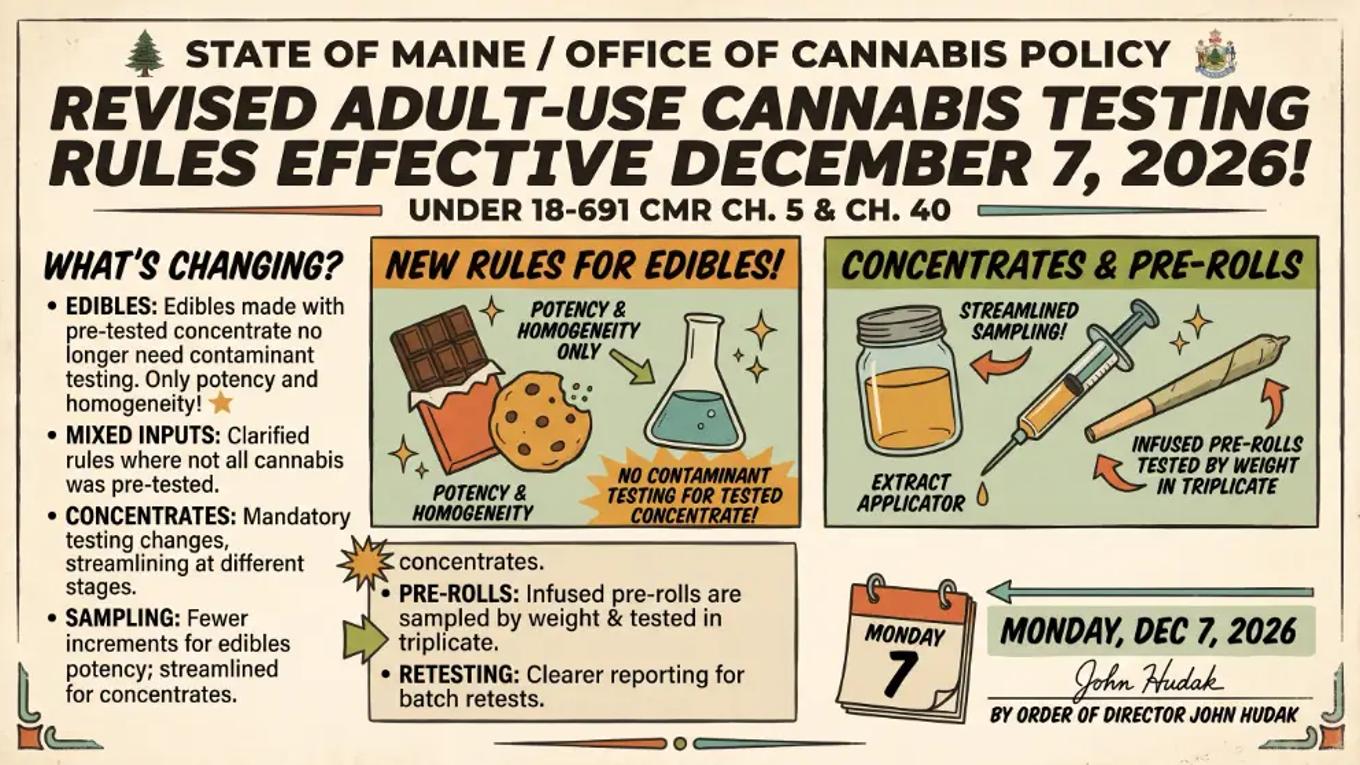
Maine's Office of Cannabis Policy (OCP) says the revised Rules for the Certification of Cannabis Testing Facilities (18-691 CMR ch. 5) and Testing Rules for Adult Use Cannabis (18-691 CMR ch. 40) go into effect on Monday 7 December 2026. The date comes from an advance notice dated 19 November 2026, signed by Director John Hudak. The rules are pending, ten days from today.
The statute behind them is already law. PL 2025, ch. 764 (LD 1488, An Act Regarding Adult Use Cannabis Testing) became law without the Governor's signature, as an emergency measure, on 19 April 2026. It amended 28-B M.R.S. § 605(4), so the rules mostly bring the text into line with the law and with OCP guidance already issued. OCP says the revisions also reflect public comments and earlier guidance.
What changes for edibles and concentrates
- Edibles: edibles made with concentrate that has passed all mandatory testing no longer need contaminant testing. The notice says they are tested only for potency and homogeneity in final form (ch. 5), or for cannabinoid profile and potency (ch. 40).
- Mixed inputs: the rules clarify which tests remain where not all the cannabis in an edible was contaminant-tested first.
- Concentrates: mandatory testing requirements change, because some contaminant tests, such as residual solvents, could previously be done at the finished-product stage.
- Sampling: the Appendix A sample collection procedure in ch. 40 needs fewer increments for edibles potency testing and is streamlined for concentrates.
- Pre-rolls: infused pre-rolls are sampled by weight. Their potency is tested in triplicate and reported like concentrates, with no per-serving or per-package results.
- Retesting: ch. 40 clarifies which potency value is reported when a licensee asks for a retest of a batch.
What changes for testing facilities
- Certificates of analysis: each must carry a photograph of the sample as received.
- Data: electronic data deliverables go to OCP every Monday by 5:00 p.m., covering results issued the previous week.
- Personnel: notice of key personnel changes is due within 5 days after the change, replacing 30 days before it.
- Proficiency testing: each method, not each analyte, must be tested every calendar year. Matrices may be tested in different years.
- Certification: all accreditation body reports, with any deficiencies and corrective action plans, go in with annual recertification. Maine CDC must accept a corrective action plan for the lab to keep certification.
- Samples: beverages are verified by volume. Oversized samples may be accepted, undersized ones must still be rejected. Metals are reported to three significant figures.
The notice says this list is not exhaustive and ends with a complete list of changes to each chapter.
What this means
The main point is that edible makers' relief is not new on 7 December. It has applied since 19 April 2026, and the new burden falls on laboratories and concentrate producers.
Edible manufacturers: the rules catch up
Under 28-B M.R.S. § 605(4), as amended, using already-tested concentrate to make an edible is not further processing, except for potency, homogeneity and cannabinoid-profile testing under § 602(1)(F). OCP guidance of 28 April 2026 said the same, and that topicals and suppositories still need full contaminant testing. Until 7 December, the written text of ch. 40 § 2(2)(A) (effective 6 November 2024) still lists the full contaminant panel. A manufacturer relying on the exemption should check its standard operating procedures (SOPs) against the new text and be able to show the concentrate's passing results.
Concentrate producers: the test moves upstream
Because residual-solvent testing could previously wait until the finished product, the revised concentrate requirements change what a concentrate batch must show on its own. The notice does not set out the detail, so read ch. 5 and ch. 40 directly.
- A failed batch must be retested, remediated or destroyed within 30 days of notice, or face an Order of Destruction (ch. 40 § 2(4)(E), (5)).
- Pesticide and metals failures cannot be remediated.
- A passed batch may not be retested to improve its result.
- Administrative penalties under 28-B M.R.S. § 802-A run up to $2,500 per minor, $10,000 per major and $20,000 per public-safety violation. A first violation draws technical assistance only.
- OCP's October 2025 recall of vape cartridges with unsafe chlorfenapyr levels shows contaminant results are enforced.
Testing facilities: most of the work, few of them
OCP's 2025 report counts 4 testing facilities and no sample collectors among 343 active adult-use licences at 31 December 2025, with 180 stores and 81 manufacturers in a $246,423,512 market. Our analysis: that is a small base to absorb new photograph, triplicate and weekly-reporting duties from one date, so licensees may want to ask their lab now about turnaround after 7 December. The notice does not say whether a transition period applies.
Labels follow the certificate
Labels must carry total THC and CBD from the certificate of analysis, and potency claims must match the lab's report (ch. 30 § 5). With infused pre-roll potency reported without per-serving or per-package results, manufacturers may want to check what figure their labels draw from the certificate. The new chain-of-custody data are meant to let labs decide whether an edibles package is within potency limits, which ties testing to the 10 mg per serving and 200 mg per package caps in 28-B M.R.S. § 703(1)(F).
Limits
- Nothing has been done under the revised rules yet. They are not in force until 7 December 2026, and OCP has not published penalty guidance specific to them.
- The notice does not state when the rules were adopted or say whether a transition period applies.
- The rules cover adult use only. The medical programme is separate (22 M.R.S. ch. 558-C). The DEA's 28 April 2026 final rule reaches only marijuana under a state medical licence and does not alter Maine's testing regime.
- We have read the notice, not the full finalised rule text.
What you need to do
- Who is affected: certified adult-use testing facilities, concentrate and edible manufacturers, cultivators and sample collectors submitting samples, and stores that rely on certificates of analysis.
- What changes and from when: both chapters take effect on Monday 7 December 2026. OCP says SOPs, records and sample collection and testing workflows should be updated before then.
- Forms and filings: the notice names the chain-of-custody form, which has new required information, and the certificate of analysis, which needs a sample photograph. It gives no form numbers. Weekly data deliverables are due Mondays by 5:00 p.m. Questions go to Gabi.Pierce@maine.gov.
- Options by reader:
- Testing facilities: revise SOPs, the sample acceptance policy and certificate templates, and plan the first weekly data file.
- Concentrate producers: check whether any contaminant testing was being left to the finished product.
- Edible makers: confirm the exemption applies to each batch's inputs.
Where to check
- OCP guidance documents: OCP guidance page. The notice's own "OCP website" link was not given in its text. Look for the finalised ch. 5 and ch. 40.
- Chapter 40 text: 18-691 CMR ch. 40. Check that it is the revised version, since we could not confirm the PDF's effective date.
- Chapter 5 summary: OCP reminders on ch. 5. Check its date, as it may predate the notice.
- Sample collection guide: Best Practice Guide for Sample Collection. The only version we found is dated 12 August 2024. The notice refers to a newly revised guide, so confirm the current one.
- The enabling act: LD 1488 bill page. It gives the chaptered law and amendments.
Sources
- OCP, Advance Notice of Revised Adult Use Testing Rules Effective December 7, 2026 (19 November 2026)
- 28-B M.R.S. §§ 602, 703 and 802-A
- 18-691 CMR ch. 40, ch. 5 and ch. 30, as currently published
- OCP, 2025 Adult Use Cannabis Program annual report
- OCP, recalls page
- Federal Register, 2026-08176
This is information, not legal, tax or financial advice.
Based on Advance Notice of Revised Adult Use Testing Rules Effective December 7, 2026 (State of Maine, Office of Cannabis Policy (Department of Administrative and Financial Services), 19 November 2026).
Information, not legal advice. Check the primary source before relying on it.