Rescheduled, registered, refused and stayed: US medical cannabis three days before the DEA's deadline
Medical cannabis has been Schedule III since April. Since then the DEA has registered 900 dispensaries, proposed to refuse others in seven jurisdictions, set a 29 November supply-chain date, and had that date partly paused by a federal court. What each strand means for a business today.
By Neil Cartwright · · 10 min read
In one line: state-licensed medical cannabis has been Schedule III since April, but the federal government is registering some businesses, refusing others, defending its order in court and arguing about its own guidance, all at once. Here is where each strand stands on 26 November, three days before the date the DEA set.
Where things stand today
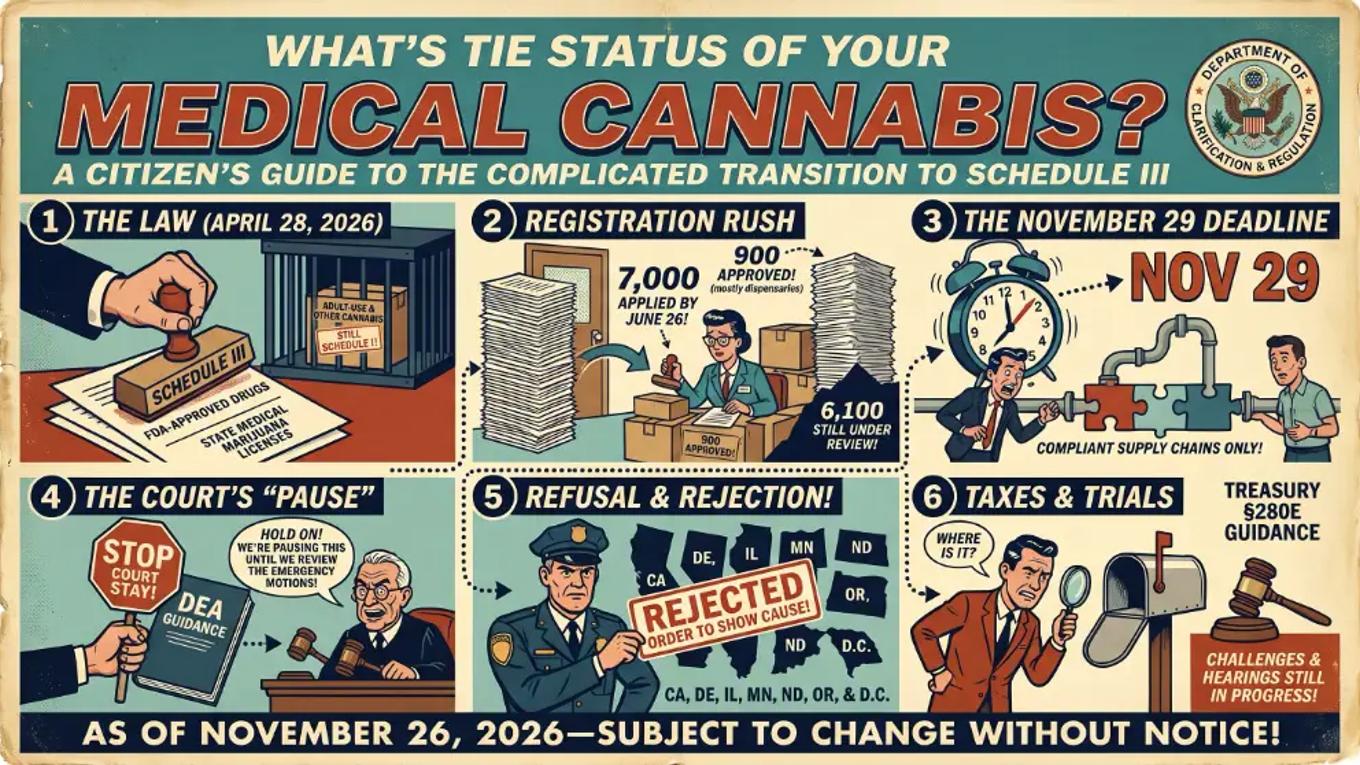
- The law: since 28 April 2026, cannabis in an FDA-approved drug and cannabis "subject to a state medical marijuana license" are Schedule III. Everything else, including adult-use cannabis, is still Schedule I.
- Registration: about 7,000 state medical licensees applied to the DEA in the 60-day window that closed on 26 June. The DEA registered about 900 dispensaries in seven states on 30 October. Roughly 6,100 timely applications were still under review then.
- The deadline: DEA guidance of 30 October says timely applicants and registrants must trade only with each other and must "establish compliant supply chains no later than November 29, 2026".
- The pause: on 25 November the D.C. Circuit administratively stayed that guidance, in part, while it decides three emergency motions from operators. It said the stay is not a ruling on the merits.
- The refusals: the DEA has issued orders to show cause, proposing to deny registration, to applicants in California, Delaware, Illinois, Minnesota, North Dakota, Oregon and Washington, D.C.
- The challenge to the order itself: opponents' petitions to set aside the April order are still being briefed in the D.C. Circuit. The court refused to pause the order on 9 September.
- The wider move: the DEA hearing on moving all cannabis to Schedule III finished written briefing on 5 November. The judge's recommendation has not been issued.
- Tax: Treasury said on 23 April that it would issue §280E guidance, including a rule treating the whole 2026 tax year as Schedule III for qualifying activity. We have not found that guidance published.
The timeline
| Date | What happened |
|---|---|
| 23 April 2026 | Final order moves state-licensed medical cannabis and FDA-approved cannabis drugs to Schedule III; Treasury announces §280E guidance to come |
| 28 April | Order published and in force; 60-day priority registration window opens |
| 4 May | Smart Approaches to Marijuana and a drug-testing trade group file the first petition against the order (D.C. Cir. No. 26-1106); state and industry petitions follow |
| 26 June | Priority window closes: about 7,000 applications (4,197 dispensaries, 2,086 manufacturers, 710 distributors) |
| 29 June to 15 July | Hearing on moving all cannabis to Schedule III |
| 9 September | D.C. Circuit refuses to stay the April order |
| 5 October | DEA opens the registration portal for manufacturers, distributors and labs, more than three months after the window closed |
| 27 October | DEA order to show cause proposes to deny a Minneapolis dispensary, citing Minnesota's dual medical and adult-use licensing |
| 30 October | About 900 dispensary registrations granted; "Timely Applicant" guidance issued with the 29 November date |
| 5 November | Final reply briefs in the wider rescheduling hearing |
| 18 to 23 November | Three groups of operators petition the D.C. Circuit to stay the guidance; consolidated |
| 23 November | DEA opposes, calling the petitions "without merit" |
| 24 November | North Dakota, Utah and West Virginia file an amicus brief supporting the operators |
| 25 November | D.C. Circuit grants a partial administrative stay of the guidance |
| 29 November | The guidance's supply-chain date |
1. The supply-chain rule, and what the court paused
In one line: the DEA told early applicants to stop trading with anyone outside the federal system; the court has, for now, stopped the DEA enforcing that against them.
The DEA's guidance, titled "Timely Applicant Information", rests on a short regulation, 21 CFR 1301.13(k)(7). It lets anyone who filed a complete application between 28 April and 26 June keep dispensing, manufacturing or distributing under their state medical licence while the DEA decides. The guidance then adds the part that has caused the trouble:
- Timely applicants and registrants "may not lawfully engage" in medical marijuana activity with anyone who did not apply in the window.
- Doing so "could be potential grounds for denial" of an application or revocation of a registration.
- Each business should check its trading partners' DEA confirmation, control number and state licence, and keep records.
- Supply chains must comply "no later than November 29, 2026". Existing inventory, including stock bought from non-applicants, may still be sold.
- Small samples may go to non-registered state testing labs, because almost no labs are DEA-registered.
- The guidance ends: it does "not have the force and effect of law".
The operators say that last line is the problem. If the guidance changes nothing, it cannot be enforced; if it can be enforced, it is a new rule made without notice and comment. Their evidence of harm is specific. Verde Americano, in Arizona, says about $600,000 of its monthly sales, 40 to 50% of revenue, go to customers who did not apply in time, and that it expects to lay off about 70% of its 136 staff. PennAlt Organics, in Pennsylvania, projects losing 95% of its third-party customers. Four Pennsylvania vertically integrated operators say they registered their dispensaries in time but waited for a manufacturer form the DEA said would come within "weeks", so their shops would be barred from selling their own cultivators' products.
The DEA's answer is that the Controlled Substances Act is a "closed system". It compared the petitioners to gas stations wanting to buy oxycodone and said they have "no reliance interests in violating federal law". Any harm, it argued, is "of their own making".
What the stay covers. The order stays the guidance "insofar as it relates to Timely Applicants' engagement in schedule III medical marijuana activities" that conform to a state licence and involve entities that are "neither federal registrants nor Timely Applicants". It is an administrative stay, to give the court time to decide the motions, and "should not be construed in any way as a ruling on the merits".
Three readings of what it means on 29 November:
- Narrow: only the guidance is stayed. The regulation itself, and the DEA's view of the closed system, are untouched. A business that keeps trading with non-applicants is relying on a temporary court order that could be lifted within days.
- Middle: while the stay lasts, the DEA cannot treat trading with state-licensed non-applicants as a ground to deny or revoke, so the 29 November date has no practical bite until the court rules.
- Wide: if the court grants a full stay pending review, the supply-chain rule is suspended for months, and the DEA would have to make it by formal rulemaking if it wants it.
The order does not say which reading is right, because it decides nothing yet.
2. The refusals
In one line: in some states the problem is not the supply chain but the state law itself.
The DEA has issued orders to show cause to applicants in seven jurisdictions. The grounds reported so far:
- Adult-use alongside medical: the DEA says states that allow non-medical sales are outside the closed system and US treaty obligations. Minnesota and Illinois dual licences have been named.
- No written recommendation: California lets dispensaries sell without a written certification, which the DEA says conflicts with 21 CFR 1301.13(k)(5). D.C. lets patients self-certify.
- Veterans' records: Illinois lets veterans qualify with a year of VA records instead of a doctor's certification.
- Treaty: the DEA reads the Single Convention as requiring "medical prescriptions" for dispensing.
An applicant can answer with a corrective action plan. Once an order is issued, it needs the DEA's approval to withdraw its application. The Cannabis Regulators Association has said the DEA's approach "created deep uncertainty and disruption for regulators, patients and market operators".
3. The challenge to rescheduling itself
In one line: the April order could still be set aside, but not soon.
Three petitions to vacate the order are consolidated in the D.C. Circuit: one from Smart Approaches to Marijuana and the National Drug and Alcohol Screening Association, one from state attorneys general (Indiana and Nebraska; Louisiana withdrew), and one from a coalition including MMJ International Holdings. They argue that 21 U.S.C. § 811(d)(1), the treaty provision the Attorney General used, does not allow a change of this kind without the usual rulemaking. The court refused to pause the order on 9 September. The parties proposed briefing ending in mid-February 2027, so that argument could be heard before the court's summer recess. A decision is unlikely before mid-2027.
4. The wider move to Schedule III
In one line: adult-use cannabis is waiting on one judge's recommendation and then the Administrator.
The hearing on moving all cannabis to Schedule III took testimony from 29 June to 15 July. It was stayed in September over a GAO report on scheduling; on 22 October the judge admitted the report and written argument on it but refused to reopen the evidence. Final replies were filed by 5 November. Next comes the judge's recommendation, then exceptions, then the Administrator's final order, then any challenge. None of these has a published date.
5. Tax
In one line: §280E has gone for qualifying medical activity, but the guidance on how to apply that has not arrived.
Treasury and the IRS said on 23 April that rescheduling "generally removes section 280E as a bar" for businesses that no longer traffic in Schedule I substances, and that guidance would follow, including a transition rule for the whole 2026 tax year. The questions it must answer are practical: how a business with both medical and adult-use licences splits shared costs, and whether a business that is refused registration still qualifies. Until it is published, tax advisers are working from the April press release.
6. The states
- Massachusetts (18 November): the Cannabis Control Commission told licensees that federal enforcement is outside its jurisdiction, that it has had no implementation guidance from federal agencies, and that the federal developments "do not change" how it administers state law.
- Missouri: warned licensees not to take part in interstate commerce on the strength of Schedule III and to keep following state law.
- South Dakota: the Attorney General said Schedule III does not change the state's medical programme.
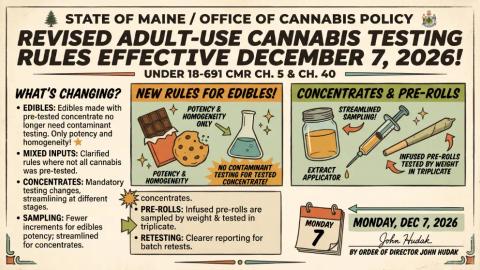
- Maine and Oklahoma: the Office of Cannabis Policy (10 November) and the Oklahoma Bureau of Narcotics have issued guidance on the federal order and registration. Oklahoma has the most timely applicants of any state: 2,442.
- North Dakota, Utah and West Virginia: filed in support of the operators, arguing the DEA's rules "disrupt" state structures.
How to read it if you advise or run a cannabis business
- Timely applicants trading with non-applicants: the stay protects you only while it lasts. Keep the records the guidance asks for, document which partners are and are not applicants, and be ready to cut over within days if the court lifts the stay.
- Businesses that missed the window: you are outside the waiver. Ask your counsel whether to apply now, and what you can lawfully sell, and to whom, if your customers are registered.
- Vertically integrated operators: check that every licensed entity in your group, not only the dispensary, applied in time. Pennsylvania's operators are in court because one did not.
- Operators in dual-licence states (Minnesota, Illinois and others): expect the DEA to ask how medical and adult-use stock are kept apart. A corrective action plan is the route offered.
- Investors and lenders: registration is now a diligence item. Ask for the DEA confirmation, control number, any show-cause order, and the company's supply-chain map.
- Tax advisers: keep a cost-allocation method for medical and adult-use activity that you could defend, and wait for the Treasury notice before filing positions that depend on it.
- Dates to watch: 29 November (the guidance date), the D.C. Circuit's decision on the stay motions (any day), the judge's recommendation in the wider hearing (no date), the §280E guidance (no date), the February 2027 end of briefing in the challenge to the order. The federal hemp change on 11 December is a separate law and does not touch any of this.
Green Ark will update this article when the court rules on the stay.
This article is information, not legal advice.
Sources
- DEA, Timely Applicant Information for Medical Marijuana Applicants (30 October 2026)
- Marijuana Moment, Federal court pauses DEA medical marijuana rules (25 November 2026); Marijuana companies file new briefs (25 November 2026); DEA pushes back (23 November 2026); third lawsuit (24 November 2026); DEA is rejecting medical marijuana businesses (11 November 2026)
- Cannabis Business Times, Cannabis operators face huge uncertainties ahead of DEA's Nov. 29 deadline (23 November 2026); November round-up
- CourtListener, Standard Wellness Utah, LLC v. DEA, No. 26-1324 (D.C. Cir.)
- DEA, Marijuana Rescheduling Regulatory Actions; order admitting the GAO report and refusing to reopen the hearing (October 2026)
- Carter Ledyard & Milburn, D.C. Circuit challenge and DEA hearing put federal cannabis rescheduling to the test (8 July 2026); Ropes & Gray, Clearing the haze; Marijuana Moment, briefing schedule in the lawsuit challenging rescheduling
- US Treasury, Treasury, IRS announce process for tax guidance following DOJ final order (23 April 2026); Thomson Reuters Tax, Dems push for IRS guidance
- Massachusetts Cannabis Control Commission, Bulletin: Federal Medical Cannabis Rescheduling and DEA Registration Information (18 November 2026); Maine Office of Cannabis Policy, guidance documents; Oklahoma Bureau of Narcotics, Director's guidance on the final order; Cannabis Business Times, Missouri rescheduling guidelines
- Marijuana Moment, CANNRA op-ed (19 November 2026)
Information, not legal advice. Check the primary source before relying on it.